I recently developed a simple UIView subclass that shows a linear gradient.
Today, I took the opportunity to publish it on GitHub, using the name GradientView.
It allows developers to integrate a gradient (between two colors) in a simple way.
Thanks to IBDesignable, the resulting view can also be displayed in the InterfaceBuilder, which helps developers to design their user interface in an interactive and responsive way (buzzwords: what you see it what you’ll get).
In the following weeks, I guess, a few other (at least one) new projects will follow.
I recently was in the position of driving a new BMW.
It was a terrific yet not special car, compared to fancy racing cars. I am talking about a rather ordinary BMW X1.
Sure, it was well designed and the engineers have optimized many aspects but that is not what I want to point out.
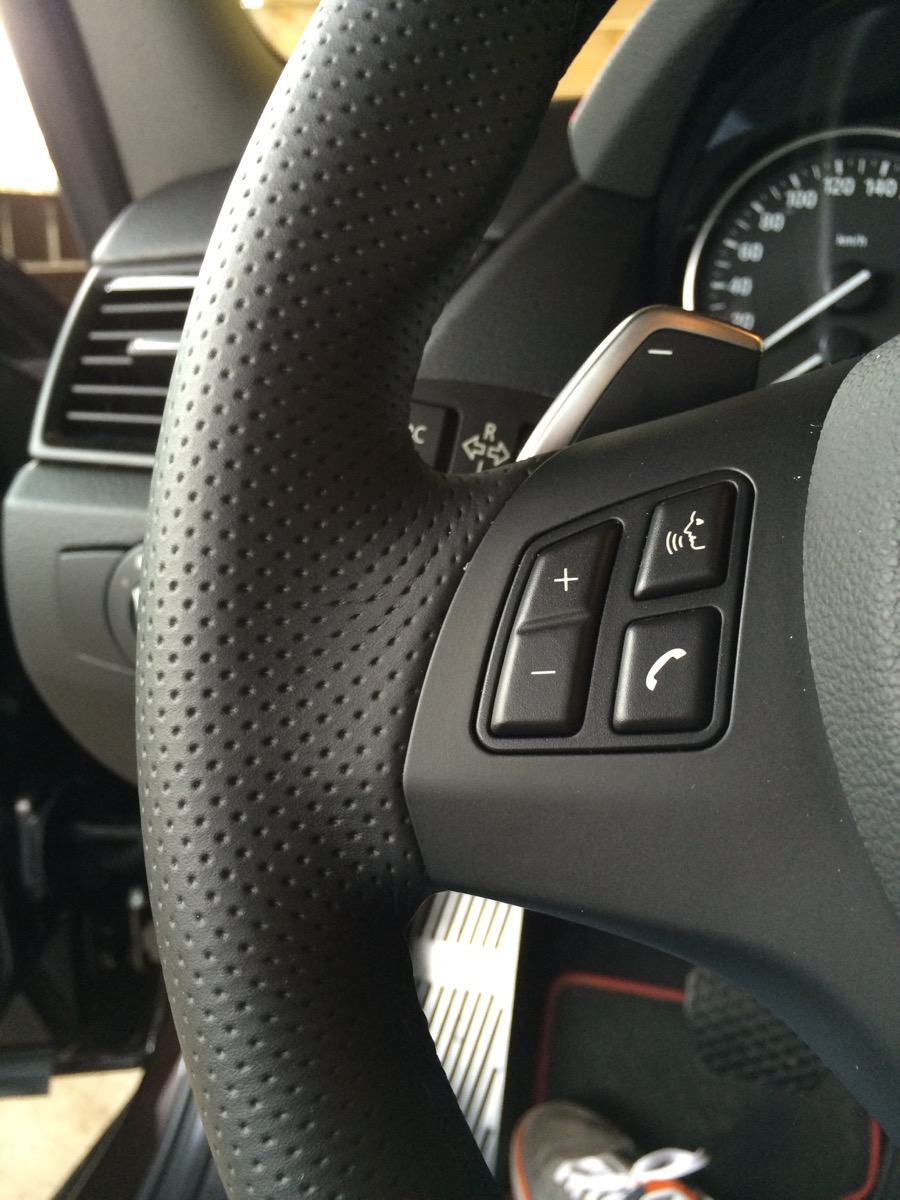
It turned out that I was most impressed by the steering wheel.
‘A steering wheel?’ you might ask.
Yes. The wheel that makes the car turn into your desired direction.
Nothing special, given the fact that every car has (to have) one.
The source of my fascination is the material.
It feels some kind of soft and grippy at the same time.
The wheel gives you the feeling that that car wants to be driven by you.
What a surprising fact, I think.
Considering that the steering wheel is something you hold on to for the entire drive, it just seems ridiculous that most of the steering wheels are heavily under-designed.
What I want to make clear is that your entire interaction with a machine, that is in the potential position to kill you (if operated inappropriately), takes place at this round peace of material.
Why can’t I find this kind of experience in many other cars? What is the reason that held the manufacturers back in making it as satisfying as possible?
That thought lead me towards another theory: Materials used for products are vastly underestimated.
Contrasting to the fact that it can make a huge difference whether something feels good or not.
Are you ready for a thought experiment?
Close your eyes (of course after you finished reading) and think about a product that feels good in your hands (or where ever you are using it).
Let me guess: the list of candidates is not a long one.
Now open your eyes and look around you. What thing makes you think ‘every time I touch or use this thing it feels good’?
Fair enough, you will most likely not think about every-day-products or even the keyboard in front of you because you use it every day and it have become a normal feeling.
My intension is to make you watch out for scenarios like this and be aware of materials that either feel extraordinary good or bad. This approach often helps to distinguish between products that stand out because of a love for detail and, on the other hand, the average.
Another example taken from my live: I loved wearing my watch, despite the fact that it was neither special in functionality (considering the actual Apple Watch debate) nor in design.
Both the link bracelet and the enclosure consists of titanium. It makes the watch feeling good, light and hard at the same time and I also really like the soft blaze.
I can't help myself, one quotation get stuck to my brain like bubble gum underneath a sneaker.
Design is not just what it looks like and feels like. Design is how it works.
You surely have heard it before and also have thought about it a lot. It may be a new notion referring it to a product as a whole.
It is not most important how something looks or feels like. It is about doing the things right of which nobody else have even thought about. A product is more than just the obvious parts.
Hopefully I was able to make you pay more attention to the details of a product and the seemingly hidden but simultaneously obvious properties like the material.
It can make the difference between a good and a excellent product that is loved by the people who use it.
The same approach applies on software as well but Ithis story will be told later on.